

The Weekly Wealth Watch
September 21, 2026
The Markets
“I’ve taken great pleasure in writing programs that do remarkable things.” — Robert Mercer, Former Co-CEO, Renaissance Technologies
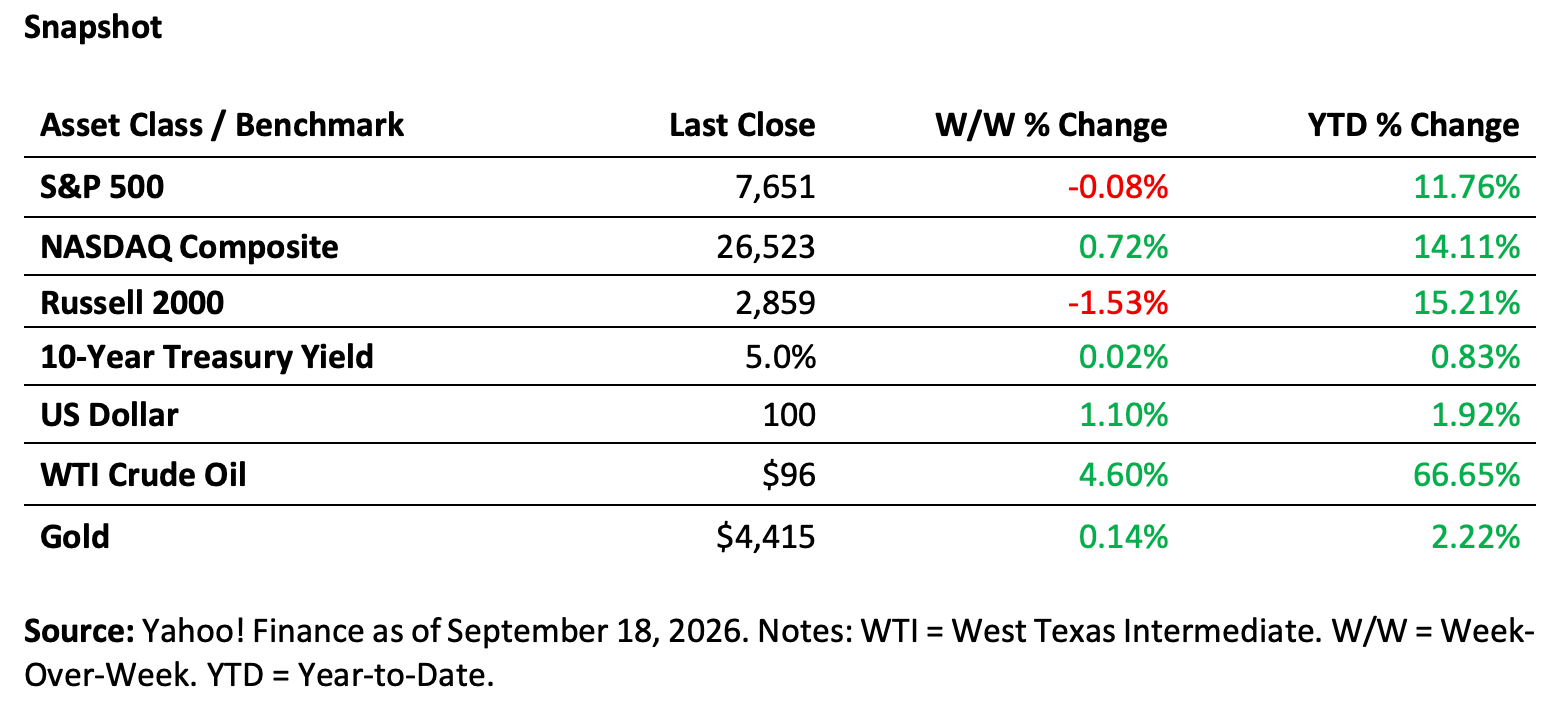
U.S. equity markets finished the week mixed, with technology stocks providing the strongest performance. The S&P 500 declined –0.08%, bringing its year-to-date gain to +11.76%. The NASDAQ Composite advanced +0.72%, extending its year-to-date return to +14.11%. Small-cap stocks remained under pressure, with the Russell 2000 declining –1.53% for the week, though it remains up +15.21% year-to-date.
In fixed income, the 10-Year Treasury yield increased +0.02%, finishing the week at 5.0%. With Treasury yields remaining elevated, interest rates continue to be an important consideration for investors across both equity and fixed-income markets.
The U.S. dollar strengthened +1.10% during the week, increasing its year-to-date gain to +1.92%.
Commodities moved higher. WTI crude oil advanced +4.60%, finishing the week at $96 per barrel and bringing its year-to-date gain to +66.65%. Gold edged higher by +0.14%, finishing at $4,415 and increasing its year-to-date gain to +2.22%.
Overall, markets presented a mixed picture. Technology shares moved higher while the broader S&P 500 was nearly flat and small caps declined. Treasury yields remained around the 5% level, the dollar strengthened, and crude oil continued its strong advance. The divergence across asset classes and equity segments highlights the importance of looking beyond the headline index when evaluating the broader market environment.
Robert Mercer’s career at Renaissance Technologies provides a fitting perspective for a market producing different signals beneath the surface. Mercer, a computer scientist who came to Renaissance from IBM, served as co-CEO and helped build the firm’s quantitative, data-driven investment approach. Institutional Investor Rather than allowing every short-term market move to dictate a change in strategy, the broader lesson is the value of discipline, data, and a repeatable process—especially when markets become noisy.
Earnings Drive Stocks, Rates Make Noise
The Fed may have grabbed the microphone this week, but earnings are still running the show.
For long-term investors, earnings have a much stronger relationship with stock prices than interest rates. In 2Q26, S&P 500 trailing 12-month operating EPS surged 35% Y/Y—an extraordinary pace outside a recession/recovery.
As Warren Buffett has famously observed: **“Price is what you pay. Value is what you get.”**¹
🚀 The Four Horsemen of the Earnings Boom
Our new Macro Momentum Indicator (MMI) using four leading economic signals:
- 🌏South Korean exports: A ludicrous 69% Y/Y in August. Korea is a global bellwether for trade, technology and semiconductors.
- 🏭ISM Manufacturing:54.6% in August. Above 50 indicates manufacturing expansion.
- 🥉Copper: Prices up 31%, despite cooling from July’s 46% pace. Dr. Copper is still reporting for duty.
- ⛏️Global industrial materials: Prices up 20%, signaling continued industrial demand.
Together, these indicators suggest peak earnings growth could arrive around 4Q26, with the MMI pointing toward roughly 40%+ Y/Y EPS growth, versus the current 36% consensus estimate.
As economist John Maynard Keynes put it, **“In the long run we are all dead.”**² Fortunately, investors don't have to wait that long for the next earnings report.
🏎️ From Ludicrous Speed to Normal Speed
The interesting part isn't whether earnings peak—it’s what happens afterward.
Cycle-on-cycle analysis suggests S&P 500 earnings growth could eventually decelerate toward 13% Y/Y in 3Q27, versus the current 15% consensus estimate.
That sounds bearish. It isn't.
Earnings growing of 13% is still earnings growing of 13%. The engine isn't stalling; it's simply downshifting as comparisons get tougher.
As hockey legend Wayne Gretzky famously said, **“I skate to where the puck is going to be, not where it has been.”**³
That’s essentially the philosophy behind the MMI: Look through today's earnings and toward the economic signals that may shape tomorrow's.
🧠 Human Interest: The Four-Cylinder Brain
There’s something wonderfully human about this whole exercise. Investors spend enormous amounts of time trying to answer one deceptively simple question:
“What happens next?”
The trick is that nobody knows. We gather clues, build models, compare history—and then occasionally discover that the economy has other plans.
Physicist Niels Bohr supposedly said, **“Prediction is very difficult, especially about the future.”**⁴
Truer words were never spoken on Wall Street.
🔢 Fun Facts & Figures
- 69%: South Korean export growth in August.
- 54.6: August ISM Manufacturing reading.
- 31%: Copper's Y/Y price increase.
- 20%: Global industrial materials price increase.
- 35%: 2Q26 S&P 500 TTM operating EPS growth.
- 40%+: Potential 4Q26 peak EPS growth.
- 13%: Prospective 3Q27 normalization estimate.
In other words, the earnings engine is still running hot. We’re just watching for the temperature gauge to come down.
📅 On This Day in History — September 21
1780: Benedict Arnold gave British Major John André information intended to facilitate the surrender of West Point during the American Revolutionary War. The plot was discovered, and Arnold escaped to British lines.
1937: J.R.R. Tolkien published The Hobbit. Bilbo Baggins began an unexpected journey—and reminded generations of readers that sometimes the biggest adventures begin with leaving the front door.
1981: Sandra Day O’Connor was sworn in as the first woman to serve on the U.S. Supreme Court.
A fitting reminder from Eleanor Roosevelt: **“The future belongs to those who believe in the beauty of their dreams.”**⁵
Bottom Line
Rates make noise. Earnings make money.
The macro signals still point toward a powerful earnings cycle, potentially peaking around 4Q26 before gradually normalizing in 2027.
So, watch the four cylinders—not just the dashboard.
The earnings engine may eventually downshift, but not stall.
Sources & Footnotes:
- Warren Buffett, widely reported investment maxim concerning price and value; Berkshire Hathaway shareholder communications.
- John Maynard Keynes, A Tract on Monetary Reform (1923).
- Wayne Gretzky, widely attributed quote regarding anticipating future opportunities.
- Attribution to Niels Bohr is widely circulated; exact provenance is uncertain.
- Eleanor Roosevelt, You Learn by Living (1960).
- FactSet, S&P Global, FRED and WCG analysis, 09/15/26.
- South Korean export data, August 2026; used as described in WCG analysis.
- Institute for Supply Management, Manufacturing PMI, August 2026.
- IMF Global Industrial Materials Price Index; WCG analysis.
Disclosures:
- Securities offered through LPL Financial, Member FINRA/SIPC. Investment Advice offered through WCG Wealth Advisors, LLC, a Registered Investment Advisor. WCG Wealth Advisors, LLC is a separate entity from LPL Financial.
- Bond yields are subject to change. Certain call or special redemption features may exist which could impact yield. (118-LPL)
- The S&P 500 is a stock market index tracking the stock performance of 500 of the largest companies listed on stock exchanges in the United States. Indexes are unmanaged and cannot be invested in directly. (102-LPL)
- The NASDAQ Composite Index measures all NASDAQ domestic and non-U.S. based common stocks listed on The NASDAQ Stock Market. The market value, the last sale price multiplied by total shares outstanding, is calculated throughout the trading day, and is related to the total value of the Index. Indexes are unmanaged and cannot be invested in directly. (112-LPL)
- The fast price swings in commodities will result in significant volatility in an investor’s holdings. Commodities include increased risks, such as political, economic, and currency instability, and may not be suitable for all investors. (122-LPL)
- There is no guarantee that a diversified portfolio will enhance overall returns or outperform a non-diversified portfolio. Diversification does not protect against market risk. (26-LPL)
The Russell 2000 Index is generally representative of the 2,000 smallest companies by market capitalization in the Russell 3000 index, which represents approximately 10% of the total market capitalization of the Russell 3000 Index. Indexes are unmanaged and cannot be invested in directly. Bonds are subject to market and interest rate risk if sold prior to maturity. Bond values will decline as interest rates rise. Bonds are subject to availability, change in price, call features and credit risk. The fast price swings in commodities will result in significant volatility in an investor’s holdings. Commodities include increased risks, such as political, economic, and currency instability, and may not be suitable for all investors.
Securities offered through LPL Financial, Member FINRA/SIPC. Investment Advice offered through WCG Wealth Advisors, LLC, a Registered Investment Advisor. WCG Wealth Advisors, LLC is a separate entity from LPL Financial.
1178676-092126